lundi 25 mars 2024

Habitats faunique de Pessamiulnut

Louis-Philippe Ménard, ing.f. -  Nature Québec  - 2018
La martre:
  • utilise des forêts de conifères matures ou vieilles.
  • utilise des forêts mixtes.
  • utilise des couverts denses pour se protéger contre les prédateurs.
  • De gros chicots, de gros débris ligneux, des souches, des amas de roches, des grottes ou des terriers peuvent servir de tanières à la martre.
  • est un prédateur généraliste et peut se nourrir d’écureuils, de tamias, de souris, de campagnols, de mulots, de belettes, de martres, de lièvres, de gélinottes huppées, de tétras du Canada, de batraciens, de couleuvres, de charognes, d’œufs, de petits fruits et de poissons.
  • Les débris ligneux sont utilisés pour la chasse.
  • peut chasser dans des espaces sous la neige.
  • Le lynx du Canada, le loup, le renard roux, l’ours noir, la martre, le pékan et des oiseaux de proie sont des prédateurs de la martre.
  • La martre évite les coupes totales pendant plusieurs années
Nature Québec  - 2018
La martre d’Amérique est un petit mammifère de la famille des mustélidés qui est souvent associé aux vieilles forêts mixtes et résineuses. Depuis l’arrivée du commerce des fourrures, cet animal représente une source de revenus pour les Pessamiulnut. Autrefois, sa fourrure était aussi utilisée dans la fabrication de vêtements et sa viande pouvait être consommée lorsque les autres sources de nourritures se faisaient rares. Après avoir consulté des Pessamiulnut et la littérature scientifique, nous avons conçu une fiche qui présente les besoins en habitats de la martre d’Amérique dans le Nitassinan de Pessamit.

Vermont Martens

Paige Fisher - vtdigger - August 18, 2023
Elusive, beady-eyed and adorable, the American marten, colloquially known as a pine marten, has a long, tumultuous history. After being practically wiped from Vermont’s landscape in the 1800s, reintroduced in the 1990s and disappearing again, these mammals now scurry among the Green Mountains, intriguing and puzzling researchers. Martens are medium-sized carnivorous animals in the weasel family. In direct competition with fishers, they mostly snack on small mammals like red squirrels. But, if enticed by denser calories, they can take down something as large as a snowshoe hare, said Jill Kilborn, biologist for New Hampshire Fish and Game ... The Endangered Species Act was legislated in 1973 and martens were listed as endangered in Vermont and New Hampshire, said Paul Hapeman, a specialist in small carnivore conservation at Central Connecticut State University. Because Vermont is the southernmost region of marten territory, there’s a good chance the martens that reside in the north are from neighboring states or Canada. And in southern Vermont, there’s a good chance they came from the reintroduction 30 years ago. And sightings of the mammals in the middle area of the state remain a puzzle, he said. His team is working to unravel the mystery by looking at the populations’ genetics, Hapeman said.  Depending on those results, that initial reintroduction effort could be a huge victory for conservationists.
Mikaela Lefrak, Daniela Fierro - Vermont Public Radio - December 18, 2023
Researchers have identified two distinct marten populations in the state—one in the Northeast Kingdom and another in southern Vermont. Brehan Furfey, a wildlife biologist and the furbearer project leader for the state, explains what makes the marten special.

Aylward, Murdoch, Kilpatrick - Nature - 28 Jan 2020
American marten (Martes americana) are a conservation priority in many forested regions of North America. Populations are fragmented at the southern edge of their distribution due to suboptimal habitat conditions. Facilitating gene flow may improve population resilience through genetic and demographic rescue ... circuit theory was used to identify potential movement corridors 

Archive

Ecology of American martens in the transitional boreal-deciduous forests of Adirondack Park

On the Doorstep: Could American Martens Recolonize Tug Hill?
NYS Tug Hill Commission - Feb 21, 2024
In the northeastern U.S., the historical distribution of American martens (Martes americana) included most of New England and New York State. However, widespread land use changes in the 19th century coupled with a lack of regulations to limit trapping harvests, led to a severe reduction in their geographic range. By the turn of the century in New York, martens were restricted to the High Peaks region of the Adirondacks, a natural refugia within this remote and rugged landscape; features which simultaneously made it inaccessible to trappers and difficult for logging. With added protections in place, marten populations began to increase in the mid-1930s and since then have recovered much of their range in the Adirondacks. In this presentation, Paul Jensen will share results of recent research on this species and discuss the potential for martens to recolonize the Tug Hill region.

Ecology of American martens in the transitional boreal-deciduous forests of Adirondack Park

ForestConnect - Mar 22, 2021
Presented 3/17/2021 by Dr. Paul Jensen. American martens (Martes americana) are small, forest-dependent carnivores that rely on complex forest structure to meet their life history requirements. Previous research in the northeastern U.S. has also demonstrated that marten populations are closely linked with pulsed mast crops (e.g., as produced by American beech (Fagus grandifolia) and American mountain ash (Sorbus americana)). These pulses result in strong bottom-up effects that have both immediate and time-lagged consequences on these predators and their small mammal prey. Please join us as Dr. Jensen discusses the fascinating natural history of these carnivores and his previous research in Adirondack Park, and shares recent results of American Wildlife Conservation Fund sponsored research to develop and deploy small (approx. 30 g) GPS collars on martens to better understand movements and space use relative to mast pulses.
Paul G. Jensen, Murray M. Humphries - Animal Ecology - 25 June 2019
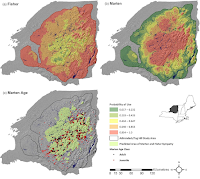
Model selection revealed that fisher use of this landscape was strongly influenced by late winter abiotic conditions, but other bottom-up (forest composition) and top-down (coyote abundance) factors also influenced their distribution. Overall, fisher probability of use was higher where late winter temperatures were warmer, snowpack was deeper, and measures of productivity were greater. Martens were constrained to areas of the landscape where the probability of fisher use, coyote abundance, and productivity were low and selected for forest conditions that presumably maximized prey availability. Marten age data indicated an increased proportion of juveniles outside of the predicted area of sympatry, suggesting that few animals survived >1.5 years in this area that supported higher densities of fishers and coyotes.

Archives